Algo trading in India used to sound like trading live behind tinted glass by people who spoke fluent mathematics.
Today, retail traders can build rule-based backtesting trading and options trading strategies, compare them to historical data, and paper trade them under live market conditions. The entirely automated execution is supported by online brokers. You do not necessarily need to write code for trading or strategy building. You do, however, need to know what you are asking the machine to do. And this is the rather important part.
Because automation can execute a bad idea with admirable efficiency.
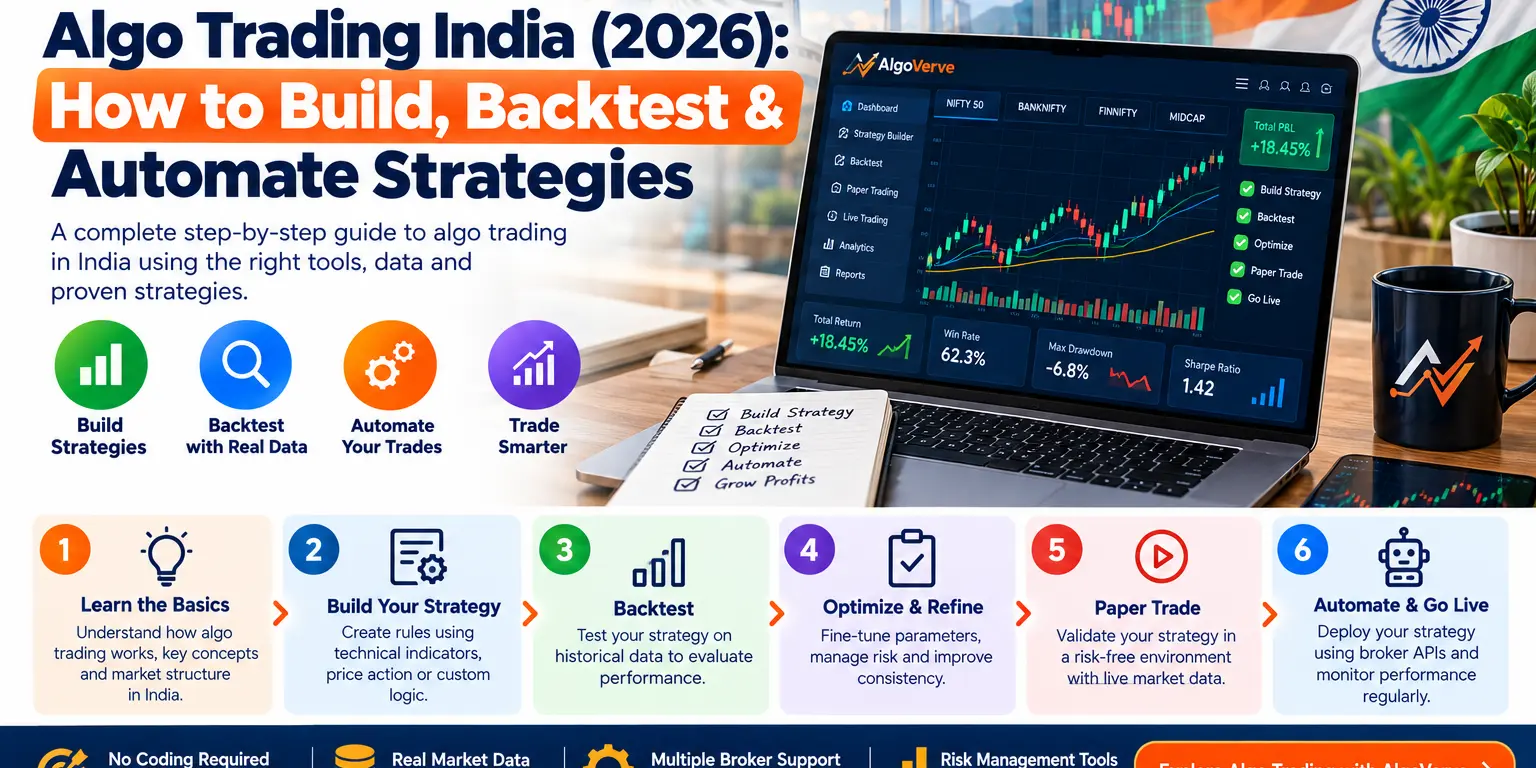
This guide explains what algo trading is, how it works, how to start, what backtesting and paper trading actually tell you, the risks involved, and what India's current regulatory framework means for retail traders.
What Is Algo Trading?
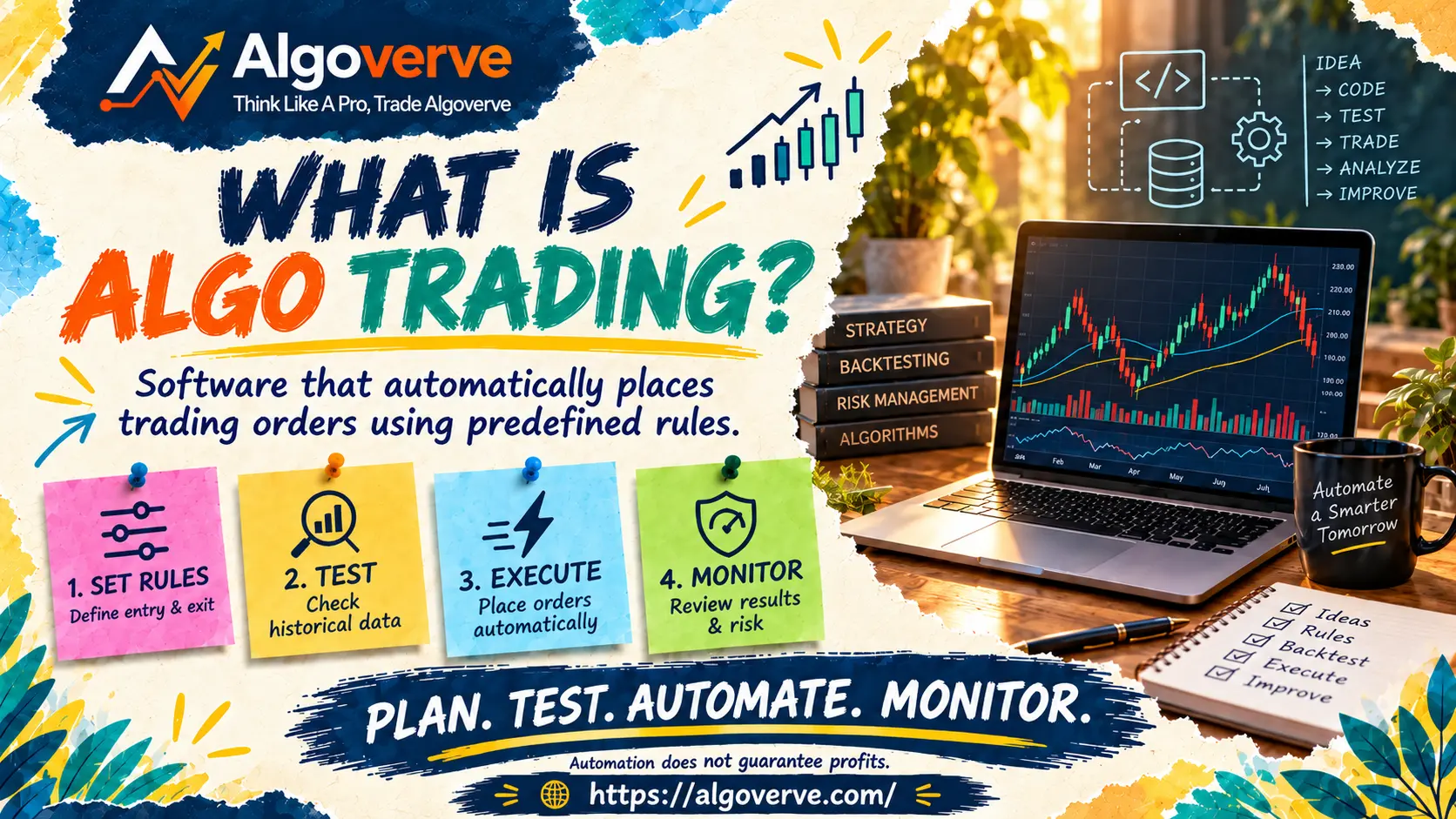
Algorithmic trading, or algo trading, is using predefined rules to analyse market conditions and execute trades automatically according to favourable, available data.
Instead of acting in the heat of the moment influenced by a chart or an indicator, you define the conditions beforehand under which the trading strategy executes. This can be done through backtesting, paper trading, or maybe a strategy that’s trading live!
You can enter when a price breaks a defined level and exit when a stop-loss or target is reached, or maybe a loss is reached. You may have traded a specific quantity during a particular time window. All that you put in a trading strategy through - what you believe to be - the best application for trading.
The system then checks those conditions through your chosen online platform for trading and acts when they are met. How accurately it’s done every time is the determining factor for what you think to be the best online trading platform in India.
Make decisions without getting panicked. The market presents opportunities aplenty to make the best out of it. You need Algoverve to catch them right upon emergence.
Algo trading can be used across equities, futures and options, and other supported markets. The exact instruments and automation capabilities depend on the broker, platform, and applicable market rules.
How Does Algo Trading Work?
In India, you can run algo trading across: I. NSE and BSE (equity, F&O)II. MCX (commodities)III. Crypto platforms
An algo trading setup usually has several moving parts.
1. Strategy Rules
The brain of every operation. Define entries, exits, position sizing, timing, and risk controls. The system will follow.
2. Market Data
Even the best application for trading needs accurate market information to operate optimally. But the question is: how accurately does it analyse that data? How precisely can it determine whether your set conditions have been met? Regarding price, volume, option-chain information, and technical indicators?
3. Broker Connection
The broker API connects the trading strategy to the trading account. When the required conditions are met, the system can send the appropriate order (buy/sell) through the broker.
4. Risk Controls
Stop-losses, position limits, maximum-loss rules, and other safeguards can operate alongside the strategy. Yet the process is extremely fast.
How fast?
It depends on the one you’re sold under the guise of the best algorithmic trading software in the Indian trading market.
Does it possess great speed? A great edge?
Not necessarily. Anything going by under the name of the best application for trading doesn’t qualify unless organic praise follows. Algoverve has plenty of them.
A machine can execute a sound strategy as fast as a terrible strategy. Technology, in its usual impartial fashion, has no opinion about either.
Is Algo Trading Legal in India?
Yes. Retail participation in algorithmic trading operates within the SEBI regulatory framework.
The SEBI circular (February 4, 2025) about safer participation of retail investors in algorithmic trading sets the framework of responsibilities for investors, stock brokers, algo providers, and market infrastructure institutions.
The implementation timeline was subsequently extended. As per SEBI's September 2025 communication, following the framework is mandatory for all stock brokers, starting from April 1, 2026.
The retail trader uses a broker and an algo setup operating within the applicable SEBI and exchange framework. The regulation creates the environment that makes automated trading absolutely transparent.
Still, there are risks. Automation just changes its nature. Not disappear.
Overfitting: a strategy may perform exceptionally well now, as it did in the past, but on unseen data, across different market conditions, it might not.
Slippage and liquidity are not necessarily the backtest price in live trading. This matters particularly in less-liquid contracts and fast markets.
Technology Failure may corrupt APIs; the connections might drop; systems can restart, breaking continuity of market data inflow.
Machines are remarkably obedient until the electricity, network, or software decides otherwise. Even the best algo trading platform can’t escape that dependence.
Market Regime Change might shake a strategy designed for a strong trend to behave very differently in a sideways market. The best trading app should allow testing across multiple market conditions and live reviews of performance against historical (read: hysterical) expectations.
Over-Optimisation doesn’t work because there are multiple parameters. Eventually the strategy fits the past so perfectly that it can’t deal with the future. Choose robust rules over beautifully optimised ones.
Can Algo Trading Be Profitable in India?
It can be. It can be, or it can be not. The machine is least bothered with how the outcome affects you.
Profitability depends on the strategy's underlying edge, execution, transaction costs, market conditions, risk management, and the discipline with which the system is designed and monitored.
The important distinction is this:
Automation does not create an edge.
It just automates the trader’s edge. Or fills the absence of one.
Through testings
A profitable backtest should always be treated as evidence to investigate. It is not a cheque from the future.
Now that AI too has entered this realm of strategy research, data analysis and optimisation, it has turned things up. Traders may now explore patterns, compare strategy variations and process large datasets within seconds. Here, the more variations, the merrier. The opportunity to discover a robust idea increases. So does the opportunity to discover a spectacularly overfitted one. But the technology will need human judgement until synthetic intelligence takes over.
Benefits of Algo Trading
The real appeal of algo trading is in a machine doing repetitive jobs faster, with better accuracy, than humans. It does so without changing its mind halfway.
More Consistent in Execution
Once entry, exit, and risk rules are defined, the system applies them consistently. Doesn’t matter if the market suddenly looks very frightening or wonderfully tempting.
Execution far less troubled by emotion
Trading strategies are free from fear and greed. And you can change the strategy out of that. If you don’t, no emotional interference will affect execution.
Faster Order Execution
Automated systems act as soon as predefined conditions are met. It decides when to trade. But fluctuating markets offer limited windows. Automation can spot and act readily.
Test Before You Risk Capital
Backtesting trading lets you examine how a strategy would have behaved on historical data before putting real money behind it. But it does not predict future returns. It gives evidence to examine.
Less Manual Monitoring
Automation checks conditions, generates signals, and places orders by itself, reducing - not eliminating - screen time. Watch the machine work as intended.
Run More Than One Strategy
Manual executions are limited to individual capabilities. Here, a person can watch multiple executions occurring at once, simultaneously.
A More Structured Trading Process
A well-defined process runs more than one trade at a time.
Throughout the workflow of: Define. Test. Execute. Monitor. Review.
That is perhaps the real benefit of algo trading.
Not that it removes uncertainty. But that it gives you a way to deal with uncertainty much better. No need to improvise every time with the market.
Conclusion
Algo trading in India is not about replacing the trader with a machine but about deciding which parts of trading should be fixed before the market turns exciting.
So rules are to be defined, tested, challenged, observed live, and automatically executed,d for which there should be evidence of success present. Automation never predicts the market.
F.A.Q.
Is algo trading legal in India?
Yes. Retail algo trading is permitted within SEBI's regulatory framework. SEBI's retail algo framework, issued in February 2025, became applicable to all stock brokers from April 1, 2026, along with the implementation standards and operational modalities issued by the exchanges.
The important part is not simply whether algo trading is legal. The broker, API, algo provider, and execution setup must operate within the applicable exchange and regulatory requirements.
How much capital do I need for algo trading?
There is no single capital amount that applies to every algo strategy.
The amount you need depends on the instrument, strategy, position size, margin requirements, transaction costs, and the maximum loss you are prepared to accept.
An options strategy, an equity strategy,y and a futures strategy can have very different capital requirements. So can two strategies trading the same instrument.
Rather than asking, "How much money do I need to start?", ask:
How much capital does this particular strategy require to operate within its risk limits?
That is a considerably more useful number.
Can beginners do algo trading in India?
Yes, but automation should come after understanding.
A beginner can start with a simple rule-based strategy, learn how backtesting works, test the strategy on historical data, and then paper trade it before committing real capital.
What should not be automated is something the trader does not understand.
Deploy, while it looks wonderfully convenient, doesn’t say what happens after pressing it.
Do I need to know coding for algo trading?
No, not necessarily, if you use Algoverve. It is a no-code algo platform that allows creating strategies using visual rules and conditions.
Coding becomes useful when you need more customized and specialised logic to create indicators or functionalities that a no-code platform does not provide.
You’re allowed to define your trading logic in simple language, clearly enough for a machine to execute.
What's the best strategy for algo trading in India?
There is no universally best algo trading strategy. A strategy might suit a trending market better or worse than another. Option trading strategies may have a very different risk profile from a strategy for an intraday breakout. Build a strategy with clearly defined rules in a logical market after sufficient historical testing of robustness across different market conditions. Check realistic transaction costs and slippage with an acceptable drawdown, ensuring a behaviour that can be monitored in live trading. Build it so well that your search for the perfect strategy ends.
Is algo trading profitable in India?
Algo trading can be profitable, but automation does not guarantee profits. The result depends on the underlying market conditions and how well you manage risks under changing conditions.