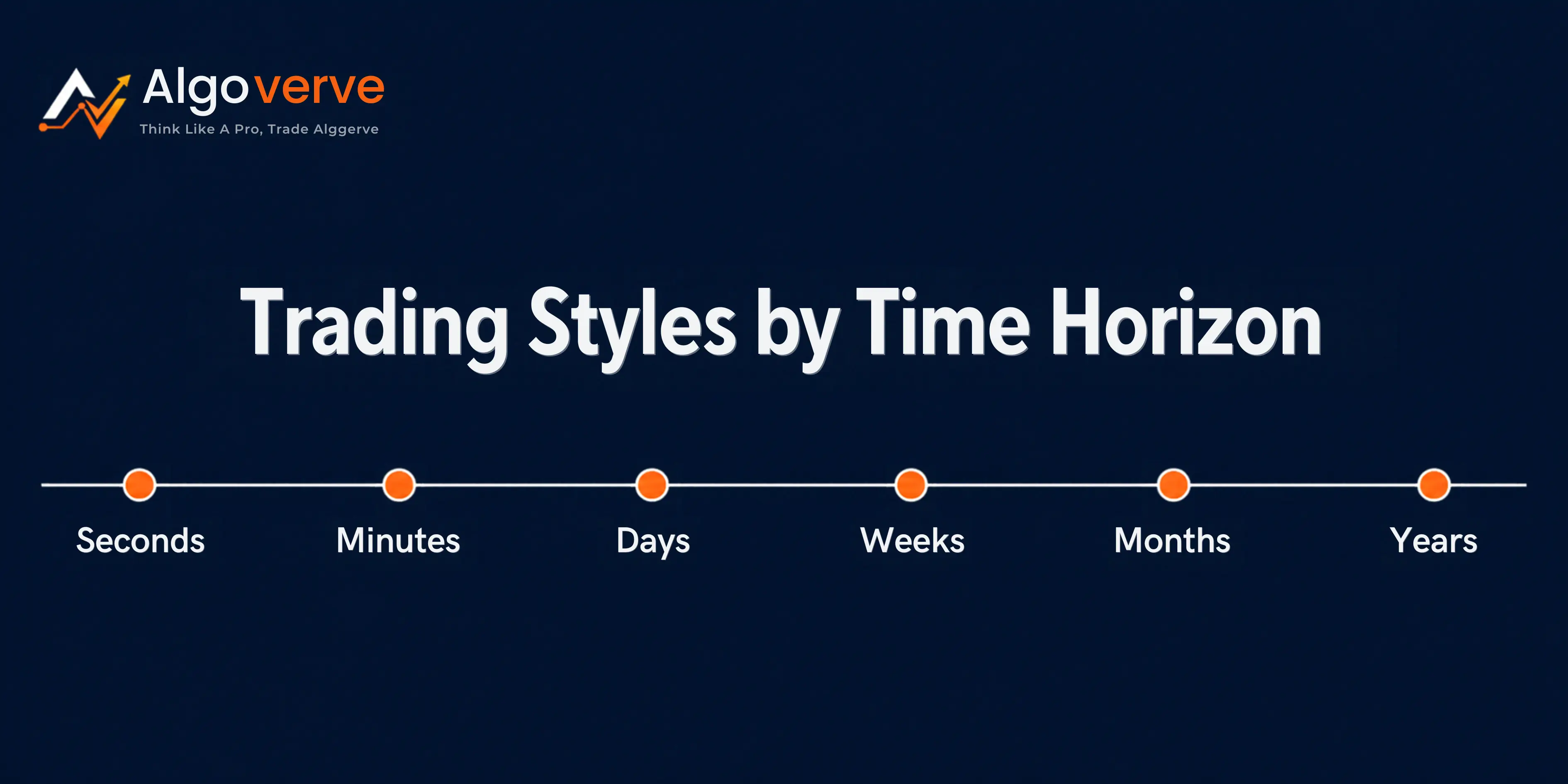
There are plenty of ways you can trade stocks. Not just buying a stock and holding it for a long time. You can trade for spans as short as a few minutes to a few hours, or a little longer (a few days), or much longer (weeks, months, or years). You can trade stocks, derivatives,s or volatility based on a chart, a company's fundamentals, a news event,nt or a mathematical model. In other words, market trading is not one activity with one rulebook. It is a collection of approaches, each with its own logic, time frame, and risks. But for someone new to stock trading in India, this can make the market look more complicated than it is. The sensible way to learn online trading is to understand what you are trading, why you are trading it,
and what could go wrong before you put real money at risk. Opening an account with an online broker is only the beginning. The more important part starts after that, where you learn how the market works and then create or find an easily comprehensible trading strategy.
Defining Stocks
Trading stocks correctly needs learning about them first. You need to know what a stock actually represents. A stock, or a company share, represents part ownership of the company whose stock you'll buy or have bought. Say there are 100,000 shares a company has issued. You bought 10. That means you own 0.01% of that company.
The value of the stock thus comes from the ownership it offers. When the company performs well, and the market values its future more highly, it makes share prices rise. If it's a struggling business, the price automatically falls. Extreme cases have seen investments turning worthless due to this factor. That stocks are often described as risk capital is due to this. You are putting money into an asset whose value can change. This is where trading gets interesting. A trader does not necessarily need to wait years for a company to grow. The trade may last minutes, days,s or months, depending on the approach. You could use an online platform for trading, a trading app, pp or another trading interface to access the market. But technology only gives you access; it does not tell you what to buy or sell, when, or how much risk you can take. That's the job of human judgement and decision.
Stock Market Trading: A Quick, Detailed View
At its simplest, stock trading is the buying and selling of stocks and other financial instruments with which you aim to benefit from changes in their prices. To begin online trading, you'll need a trading account, a demat account (for holding securities), and the required market infrastructure. The account needs to be activated and appropriately funded before you can start placing orders through your online broker. Now, you can buy a stock in the morning and sell it before the market closes. You might hold it for a week because you expect a short-term trend to continue. Or you might hold it for much longer because your view depends on the business rather than the next few price movements. Mark the important point here. Trading is defined less by how long you hold something. It's the reason and the method behind the trade that matters. What information might a trader use? Many kinds. Company results, economic data, price charts, technical indicators, news, predefined rules — everything counts towards making a decision. Increasingly, those rules can also be executed through algo trading and algorithmic trading, where a computer follows predefined conditions instead of waiting for a human to click Buy or Sell.
How Does Stock Trading Work and How to Start Trading?
Stock trading begins with access to the market.
Page 2 of 7Ways to Trade Stocks — formatted for Algoverve. You generally need a trading account with an online broker, along with the necessary account for holding securities. You then use the broker's system, website, or trading app to view prices, place orders, and monitor positions. The order reaches the exchange, where trades are matched according to the applicable market mechanism. For someone beginning trading in India, this process can seem more complicated than it is. At a basic level, it looks like this:
Step | Action |
|---|---|
1. Account opening | Trading and demat accounts are set up. |
2. Add funds | Provides the margin required for the trade. |
3. Market study | Check price, news, fundamentals and every relevant data. |
4. Choose strategy | Decide the reasons for entry and exit. |
5. Placing an order | Through the broker's platform or a trading app. |
6. Position monitoring | Track the course of the trade to manage risks. |
7. Exit | Position closes as you planned. |
Choose an appropriate online platform for trading to make the above data useful. The platform makes it easier to see what is happening, place orders, and manage positions. If you are exploring automated strategies, you may also look for features such as strategy creation, backtesting, paper trading, and automated execution.
But do not let the search for the best trading app become a substitute for learning. A good platform can only improve execution. It cannot improve a strategy that makes no sense.
The same applies to searches for the best-rated trading platforms or the best online trading platform in India. Best depends on what you actually need — investing, intraday trading, derivatives, charting, automation, research, or something else.
Types of Stock Market Trading
There is no single way to trade stocks, as you were told earlier. You can use different time frames, information, and methods. You may watch charts all day, or you may hold positions for days, weeks… even months. If you really love figures, you can use mathematical models through automated systems.
Read about some of the most common forms of stock trading.
Intraday Trading
You buy or sell a stock during the trading session and close the position on the same day. Since you didn't carry forward your position, there is no delivery of the stock from the trade. Or you may short sell. It is possible in intraday trading, subject to applicable market rules.
Swing Trading
Hold a position for several days or a few weeks. Then attempt to capture shorter-term moves within a broader market trend. It's a fairly obvious challenge because the market does not always behave your way within the span you mention.
Scalping
It is a very short-term form of intraday trading. Positions may remain open for seconds or minutes. The potential gain from each trade can be small, so make repeated trades and tighten execution. Trading costs for scalping, therefore, matter a great deal.
Trend Trading
Uses price behaviour and technical charts to identify an existing trend. A trader may attempt to participate in the trend or trade a breakout when the price moves beyond an important level.
Arbitrage Trading
Attempts to benefit from price differences for the same or related instruments across markets or segments. The opportunity may arise because prices are temporarily out of line. The difference may look small, but repeated opportunities can make the approach useful when executed efficiently.
Event-Based Trading
Built around events that often affect prices. These include corporate announcements, mergers, dividends, earnings, or other significant developments. You take a position based on an expected market reaction. The awkward bit is that markets sometimes react differently from what everyone expected.
Positional Trading
Involves holding positions for a longer period than typical short-term trading. Traders may use technical or fundamental analysis to identify a broader price opportunity and hold the position until their objective or invalidation point is reached.
Volatility Trading
Focuses on changes in market volatility rather than simply whether a stock will rise or fall. Options are commonly used for this purpose. This is also where understanding option trading strategies becomes important because an option's value depends on several factors, not just the direction of the underlying asset.
High-Frequency Trading
Uses computer systems to execute a large number of orders at very high speed. These systems depend on low latency, sophisticated infrastructure, and automated decision-making. This is not simply any normal trading that's faster. Its underlying technology and economics are greatly different.
Quant Trading
Makes use of mathematical and statistical methods. It identifies patterns or relationships in market data. Quantitative models can be highly sophisticated, which is precisely why they are not shortcuts to easy money.
Another Approach: Algo Trading
Here, you convert a set of trading rules into instructions a computer executes. An algo trading strategy specifies when to enter, when to exit, how to manage risk, and what conditions should invalidate the trade.
Algo trading strategies have become everyday words because now they are more accessible to individual traders. Though there's an important distinction.
Before trading live, a strategy can be tested using historical data through backtesting. That can help you understand how the rules would have behaved under past market conditions.
It cannot tell you what the future will do.
Likewise, searching for the best algorithmic trading software is not a substitute for understanding the strategy you intend to run. The machine may execute your rules perfectly. It cannot tell you whether the rules deserve your money. Stock market trading therefore has more subtleties than the simple instruction to buy low and sell higher. The better way to learn is to start with one approach, understand its mechanics, and gradually build from there.
Trade or Invest?
Both involve putting money into financial markets. The difference is in the objective, time horizon,n and method.
Trading | Investing |
|---|---|
You focus more closely on price movements and seek to benefit from shorter- or medium-term opportunities. | Generally has a longer time horizon. |
You take decisions based on charts, news, technical signals, market behaviour, or a defined trading strategy. | The focus may be on the underlying business, earnings, valuation, growth prospects and the price paid for that ownership. |
Neither is superior by default.
A long-term investment can lose money. A short-term trade can make it. And exactly the opposite. So don't ask whether trading is better or worse than investing. It is whether you understand your approach.
Beginners, take note when moving from traditional investing towards algo trading, algorithmic trading, ng or derivatives. Technology has made access easier. An online broker, trading app, and modern online trading platforms can put markets at your fingertips within a few taps. The market itself, unfortunately, has become more complicated. That is why you should learn before trading live. Understand the instrument and the strategy. Test them where appropriate. Know the risks. Then decide whether you are ready to trade.