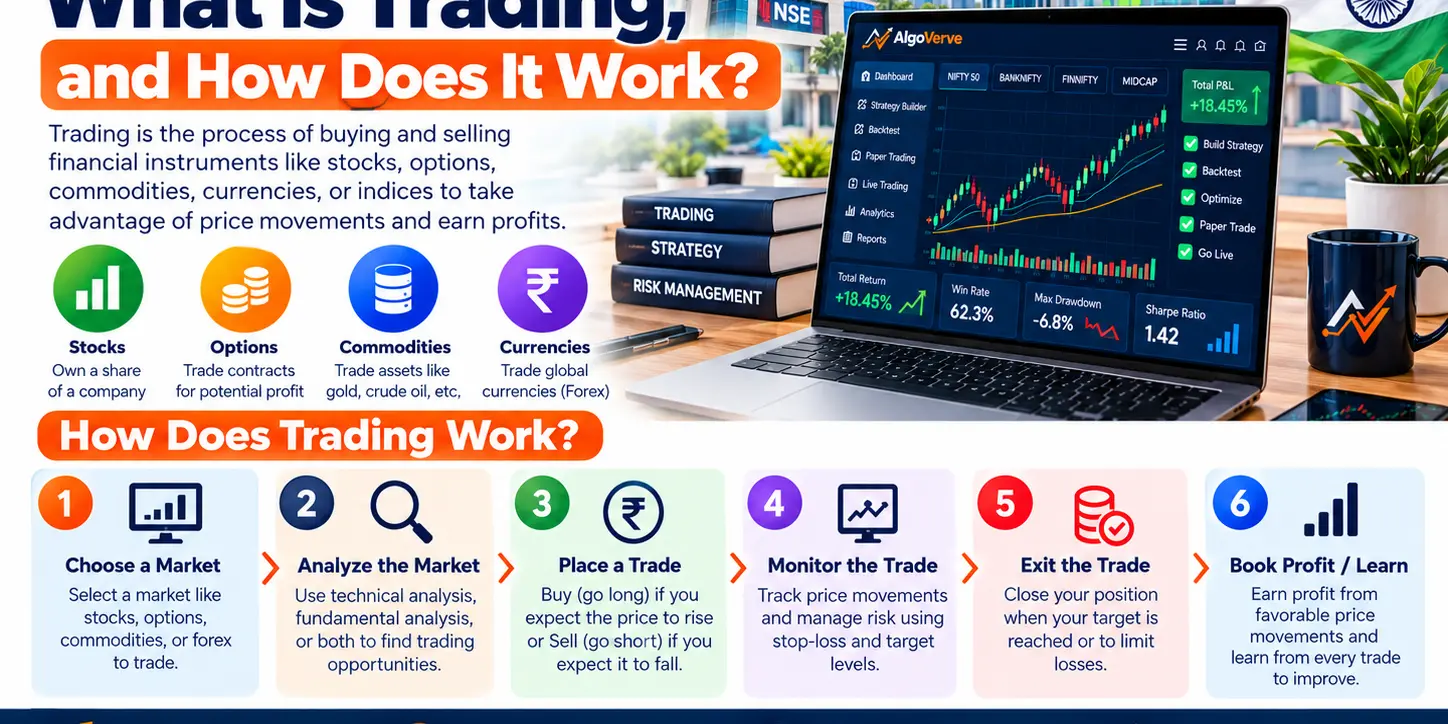
Trading is the process of buying and selling financial assets, such as stocks, options, currencies, commodities, or cryptocurrencies, to potentially earn a profit from changes in their prices.
For example, if you buy a stock at ₹100 and sell it at ₹120, you make a gross profit of ₹20 per share. However, if the price falls to ₹80 and you sell, you lose ₹20 per share. Brokerage fees, taxes, and other charges can also affect your final profit or loss.
Learn Trading and the Ways It Works
Trading is buying and selling something because you expect its price to rise. If it rises, you sell. If it falls, you buy more, if you have the capital and the intention.
Sounds quite simple. Till the market gets involved.
Then you learn it’s not just the price. Stocks, indices, futures, options, and other financial instruments - all move for different reasons.
Understanding market trading means understanding what you are trading. Why its price moved.
A lot happens in the time between placing an order and closing the position.
We break trading down into its basics. We tell you:
- How it works
- What you can trade
- Who participates
and
- When not to invest.
CTA: Start here to learn how trading works.
What are we covering?
Know trading for real.
- How does a trade work?
- How do you start trading?
- What does trading look like in practice?
- All that you can trade.
Who actually trades in the markets?
Trading or investing? Learn to choose.
Know trading for real.
Trading sounds glamorous until you start.
Rumours make it worse. Every time the charts move, or prices jump, someone on social media announces a stock that’s on the verge of exploding. Another person announces a market collapse. Your phone vibrates every time those things occur.
Somewhere in the middle of all this noise, you have to make a decision.
That’s trading. More exactly - it’s as follows.
Trading is buying and selling financial instruments, aiming to profit from the sale if price movements go on a rise. If not, you sell to minimise loss.
This is simple enough, but how to get the direction right is the hard one. You may trade in stocks, indices, futures, options, commodities, currencies, bonds, and exchange-traded funds. The basic idea remains the same.
You are required to take a position to start trading by buying or selling a financial asset. You do it with a view of what the market may do next. If it moves favourably, it generates a profit. It might not if the timing and the direction are wrong. The market consistently ignores your emotions and preferences.
How Does a Trade Work?
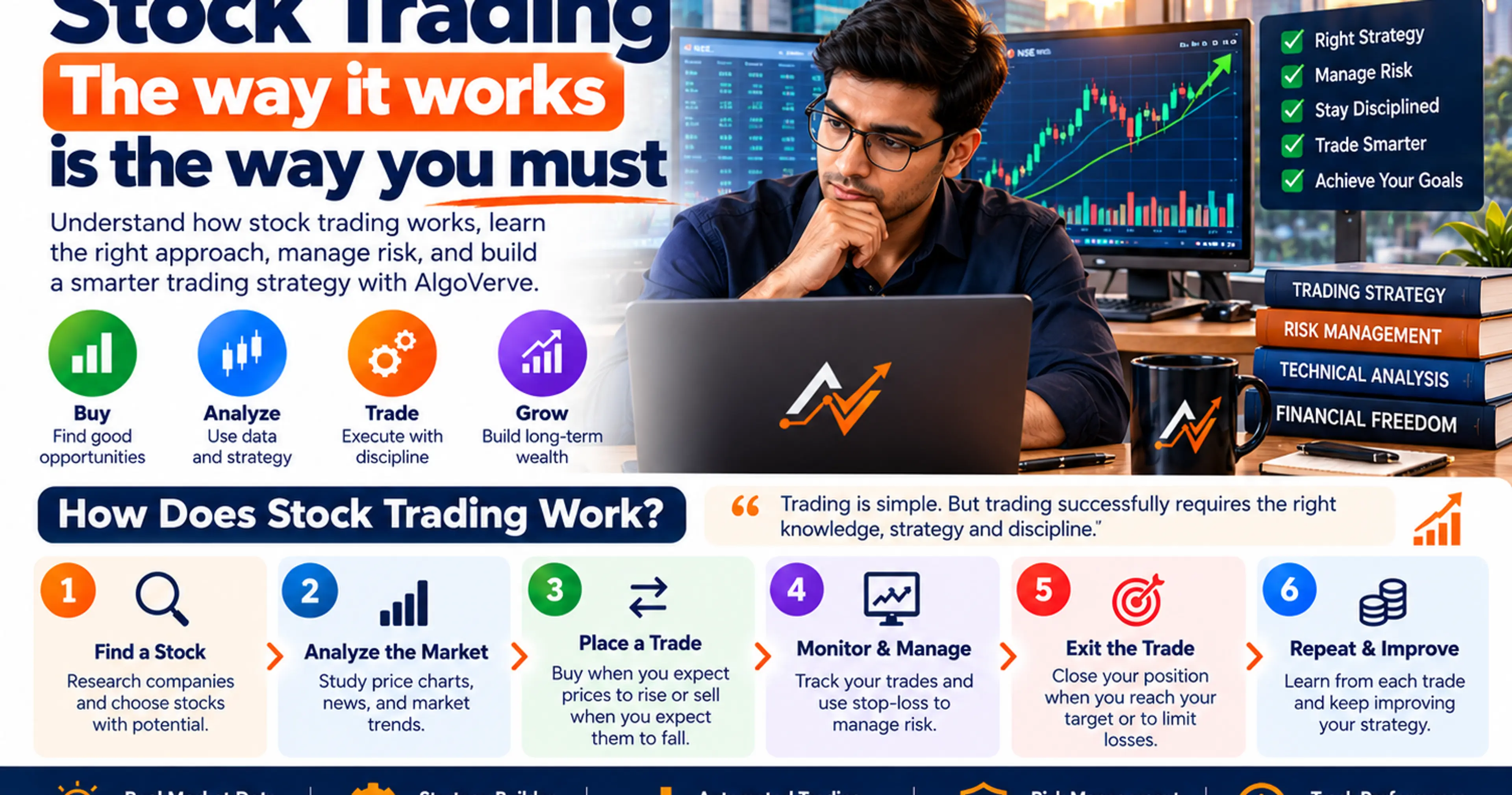
Three parts to trading: Decide. Enter. Exit.
Decide what you want. That’s your expectation from the market.
Take a position and enter a trade.
You exit the position when you reach your target. By means of a stop-loss. Maybe a time limit. Or due to some other condition.
You expect a stock to rise from a market view.
You enter a trade buying that stock at ₹500. You set a target at ₹540, with a stop-loss at ₹480. Exit once you sell either when the target is reached, or it goes down to the stop-loss.
Now, real trading is more complicated. Because knowing how the markets might move requires reading the neat little straight lines, right?
How do you start trading?
Know what you can trade first. Because the market isn’t a single entity. There are many.
In India, retail traders commonly come across equities, indices, futures, and options. Sometimes commodities and currencies. Each of these markets behaves differently.
Stocks help you buy a share of a company. A stock trader may buy because they expect the stock price to rise. So that they can be sold later at a higher price.
Indices are a group of stocks. It’s an index in the plural. The Nifty 50 and Sensex are the most familiar. In India.
Traders use index-based instruments to express a view on the broader market. They do it instead of taking a position in one company.
BUT! You do not start trading by placing a trade, unlike the many making this mistake.
Start by deciding what you want to trade, why you want to trade it, how you intend to trade it, and what you are prepared to lose if you are wrong. Only then does the order button start looking interesting.
So, choose your market first. As a beginner, stocks are your safest choice.
Someone else may be interested in option trading strategies, where the trade is built around direction as much as time and volatility. But they would be intermediate, at worst. You’ll take some time to get there.
The SECRET is - Not to trade everything simply because your online broker allows/tells you to. Your online broker provides access to the market and the infrastructure needed to place, modify, and monitor orders. Just that much. Your menu is not your trading strategy.
You need to open a trading account after you’ve chosen your market. To trade securities in India, you generally need the appropriate trading and demat setup with a regulated intermediary.
Today, much of this happens through an online platform for trading or a trading app. You can usually see prices, charts, positions, orders, and account information from the same place.
Is it convenient? Absolutely!But sometimes, it's a little too convenient. That convenience often fuels rash decisions.
A trade can be placed in seconds. Making that decision might take days. Because you need to understand your order before placing it.
The order types and conditions are not technical decorations on a trading screen. They determine how an order behaves once it meets the market, which is under no obligation to behave politely.
A market order seeks execution at the best available price. A limit order specifies the price at which you are willing to trade.A stop-loss order helps limit damage if the market downswings.
With a trading strategy - the defined set of rules deciding when to enter, exit, and when not to trade in between - you can logically back up your trade, increasing probabilities for higher profit margins.
That decision may come from the price action, analysing technical indicators, or by following a certain trend. All is a framework within which the market should fit; maybe for a couple of seconds to make you emerge as a winner. Quick detection and fast execution to utilise that moment is possible only through best-rated trading platforms in India.
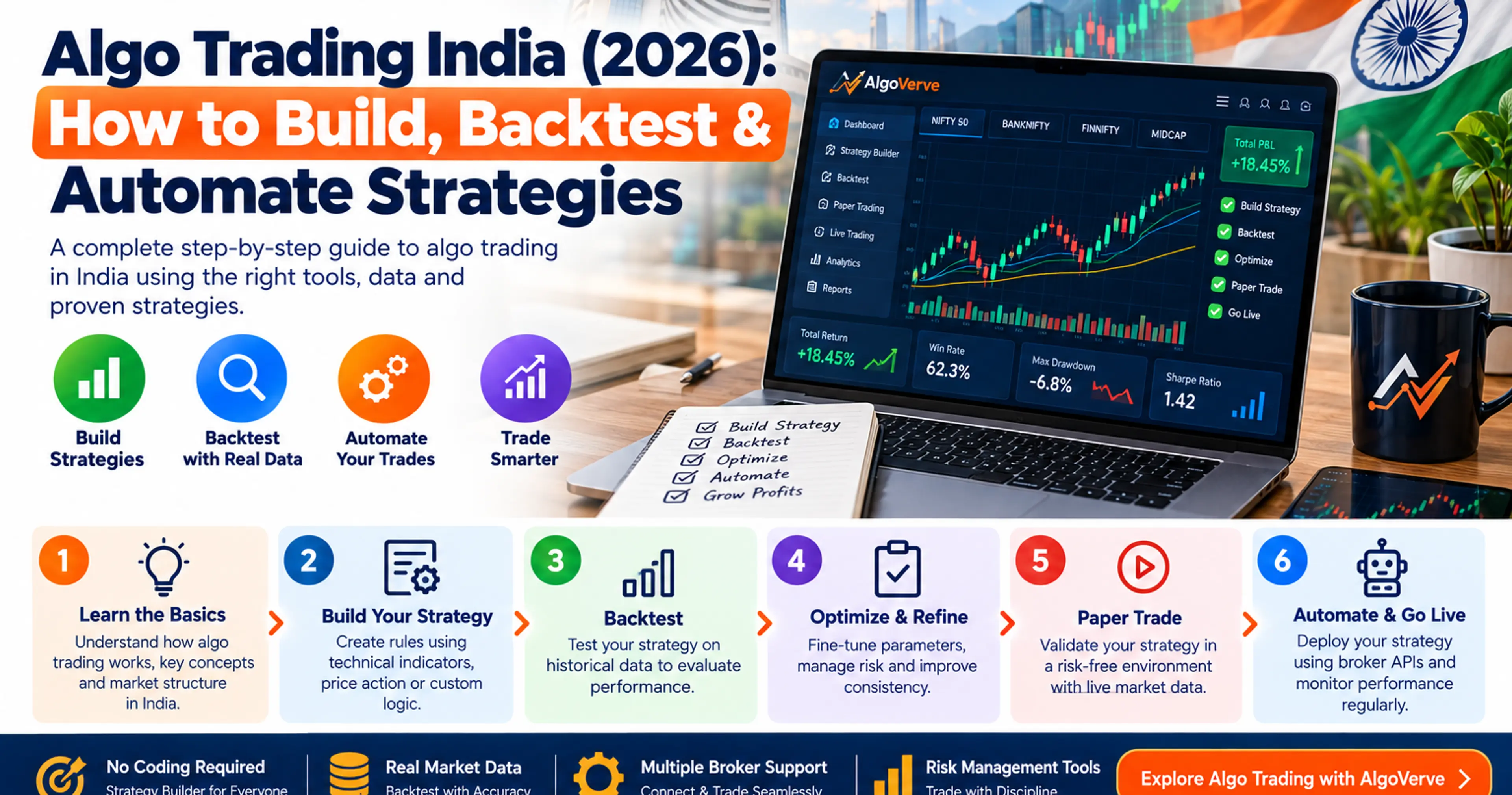
Test before trading live!When the future is uncertain, the backtest works as a rear-view mirror, not a crystal ball. Backtesting trading strategies applies a set of trading rules to historical market data to see how they would have behaved in the past.
Suppose the strategy says:
- Enter when a particular condition occurs.
- Exit when another condition occurs.
- Keep the maximum loss within a predefined limit.
Those rules can be tested against historical data. The objective is not to prove that the strategy will make money in the future. The objective is to discover how the strategy behaved under different market conditions before actual capital gets involved.
A brilliant-looking strategy can behave very differently in the charts during backtesting and paper trading while bringing a result entirely unthought about. Execution time, costs, slippage, and changing market conditions - all contribute to it.
Don’t think about removing uncertainty. Get the evidence with which to deal with it.
Try paper trading too. A paper trade tells you whether you actually follow your own rules when a position moves sharply against you. These are simulated trades that need no real money. You run your strategy in the live market and see how it behaves in the environment, as prices move. See if it’s sensible for the actual market.
What does trading look like in practice?
Let us make this less theoretical.
Suppose a stock is trading at ₹1,000, which you believe shall rise in price. So buying 100 shares will create a position worth ₹1,00,000. If the price rises to ₹1,050 and you sell, you make ₹5,000 before applicable charges and taxes.
But suppose the price falls to ₹950 instead. The same trade now produces a ₹5,000 loss.
Your view was the same. Your position size was the same. Your trading platform was the same. It’s the market that simply moved in the opposite direction.
That is what trading looks like in practice: you take a position based on an expectation of price movement, and your profit or loss depends on what the market does after you enter.
A trade has a beginning and an end
Every trade has, at its simplest, three things:
An entry.
The price at which you open the position.
A position.
What you currently hold or are committed to — for example, 100 shares.
An exit.
The price at which you close the position.
Profit comes from buying first and selling later at a higher price.
A loss occurs when you buy first and sell later at a lower price.
Or you may take a short position when you expect prices to fall. In that case, you’ll open the trade by selling and close by buying back later. The difference between the opening and closing price, multiplied by the position size, determines the gross result.
Costs still have their say. That includes brokerage, exchange charges, taxes, spreads, and other applicable costs. Together, they reduce the final profit or increase the effective loss.
Shift focus to the trading screen now.
In an online trading setup, the process starts with selecting an instrument with its current price and market information. Specify the quantity and order type before placing the order through your online broker you connect with the trading app. Executing the order gives you a position, which you monitor until you close it, or a predefined condition closes it.
This one reason makes an online platform for trading look deceptively easy. With the mechanics taking seconds, the decision behind them, which may take hours of research, testing, and thought, often gets overlooked.
And this is where algorithmic trading changes the process.
With manual trading, you interpret your rules and make the decision yourself.
With algorithmic trading, those rules can be expressed as a set of instructions that a system can execute when the specified conditions occur.
For example:
Buy when the entry condition is met.Exit when the target or stop-loss condition is met.Do not enter if the risk condition is not satisfied.
The principle remains the same. You are still taking a position because you expect a particular market movement. The difference is that the execution can be systematic rather than dependent on you watching a chart and deciding what feels right at that particular moment.
That makes testing important.
Before trading live, you can use backtesting methods to examine how your rules would have behaved against historical data. You can then use paper trading or forward testing to see how the strategy behaves in a live market without immediately putting real capital at risk.
Aim not to predict the future but to understand your strategy better before asking your money to do the work.
And that is perhaps the most practical way to look at trading:
You are not simply buying and selling. You are putting a defined view, a defined set of rules and a defined amount of capital to work - and then finding out whether the market agrees with you.
All that you can tradeStocks are only the beginning. Depending on the market, your broker, and the products available to you, a range of financial instruments - each with a different way to take a price view - can be traded.
- Stocks: For many people, stocks are the most familiar entry point into market trading. Stocks give you ownership in a company, and you buy them when you expect their prices to rise. You sell them later for a higher price. You can also short sell (sell at a higher price and buy back when prices drop) shares where short selling is permitted. But you need to know the company well and know where its stock price will go next.
- Indices: An index represents a group of stocks instead of a single company. E.g., Nifty 50 and Sensex.
Trading an index brings exposure to the movement of a broader market or its segment, without taking a position in every individual constituent. This makes indices particularly useful for traders working with broad market movements rather than with individual companies.
- Futures: These are useful but less forgiving contracts to buy or sell an underlying asset at a specific price and date. This is fixed according to the terms mentioned in the contract. With futures, you may take directional positions, or you can manage exposure. However, since futures require only a fraction of the contract's total value as margin, a relatively small movement in the underlying market can produce a much larger gain or loss relative to the capital committed.
- Options: Options allow traders to buy or sell an underlying asset at a specified price within defined terms but without any obligation. Since calls and puts provide different ways to express a market view, it makes options versatile and considerably more complex than simply buying a stock. With option trading strategies designed around volatility, time decay, or combinations of multiple options, you may trade either with them or straightforward (directional trades). But the flexibility also brings additional risks.
- Commodities: Commodities like gold, silver and crude oil can be traded through the relevant, available market instruments. Commodity prices respond to supply and demand, geopolitical events, currency movements, and weather, among other factors, which can be very different from factors affecting an individual company's stock.
- Currencies: Currency markets allow traders to take positions on the relative value of one currency against another. Thus, currency trade is always a comparison, and you trade one currency against another. Exchange rates are influenced by interest rates, inflation, economic data, central-bank decisions and geopolitical developments.
Who actually trades in the markets?
Not just suit-clad individuals shouting over the telephone. The markets bring together people and institutions with very different objectives, time horizons and amounts of capital.
Individual traders
These are retail traders; individuals trading their own money through an online broker, trading app or other online platform for trading.
Some trade occasionally, some daily. Some focus on stocks; some on the indices, futures, options or commodities. Their reasons can be equally varied.
Some look for short-term price movements. Others hold positions for weeks or months. Some build systematic strategies and use algo trading to execute them. What they have in common is that they are trading their own capital.
Institutional traders
Then there are the large institutions.
Banks, mutual funds, pension funds, insurance companies, asset managers and other financial institutions may trade on behalf of their organisations or their clients.
The scale can be very different from that of a retail trader.
A fund buying or selling a large position can itself affect the market price.
This is one reason markets are not simply a collection of individual traders making isolated bets.
Every order meets another order.
Every buyer needs a seller.
Every seller needs a buyer.
Professional traders
Trading can be a full-time profession, whether working as an isolated trader or as a bank-employed professional, as an employee of proprietary trading firms, hedge funds, brokerage firms, or other financial organisations.
Their strategies can range from discretionary decision-making to highly systematic algorithmic trading. The only two similarities they share are:
- Where to find the opportunity?
- What risks can they run into if their decisions are wrong?
Market makers and liquidity providers
Some participants are not primarily trying to predict whether a stock will rise or fall.
Market makers and liquidity providers may continuously quote buying and selling prices, helping create liquidity in the market.
Their business is built around facilitating transactions and managing the risks created by the positions they take.
So the person on the other side of your trade may not have the same view of the market that you do.
They may have a completely different objective.
Algorithms trade too
Increasingly, markets are also populated by automated systems.
Algorithms can monitor prices, identify predefined conditions, and place orders according to programmed rules.
This is the machinery behind much of modern algo trading and algorithmic trading.
An algorithm does not have a hunch.
It has instructions.
If the conditions are met, it acts.
If they are not, it does nothing.
That does not automatically make algorithmic trading better than manual trading. A badly designed strategy can simply lose money with impressive consistency.
So who is on the other side of your trade?
It could be another retail trader.
It could be an institution.
It could be a professional trader.
It could be a market maker.
It could be an automated system.
And sometimes, the person or system taking the other side may have a completely different reason for doing so.
You may be buying because you expect the price to rise.
Someone else may be selling because they are reducing risk.
Another trader may be hedging an existing position.
An algorithm may be following a predefined rule.
The market does not require everyone to agree. It only requires orders to meet.
That is what makes market trading a market in the first place.
Trading or investing? Learn to choose.
Trading and investing both involve putting money into financial markets, which largely ends their similarity. The difference is not simply how long you hold something; it is why you are holding it in the first place.
Investing looks further ahead.
An investor typically buys an asset because they believe it can create value over a longer period.
You might buy shares in a company because you believe its business will grow. The company may increase its profits, expand into new markets, pay dividends, and make its value rise over time. The investor is therefore often more concerned with the underlying asset and its long-term prospects than with what its price does tomorrow morning.
That does not make investing passive. Good investing still involves research, valuation, portfolio construction and risk management. It simply operates on a different clock.
Trading looks at what happens next.
A trader is usually more focused on price movement every minute, hour, day, week, or even month. The question is not necessarily if the company is great but: Is there a trade here?
The underlying company can remain perfectly healthy while its stock provides a trading opportunity. But the reverse can also happen, making the stocks of a wonderful company trade poorly at a wrong price.
So while an investor may buy a stock believing that the company could be worth substantially more over the next five or ten years, a trader may buy the same stock at the same price because their trading strategy suggests it could move higher in the near term.
An investor may tolerate considerable short-term price movement because the investment thesis has not changed. Whereas a trader may exit quickly if the price moves against the strategy.
Which approach is inherently superior? - Neither. Because they are designed for different objectives.
Which one should you choose?
That depends on what you are trying to do with your money.
If you want to participate in the long-term growth of businesses or markets and can tolerate holding through shorter-term fluctuations, investing may be more appropriate.
If you want to take defined positions around shorter-term price movements and are prepared to manage them actively, trading may suit you better.
And there is no rule saying you must choose only one.
A person can invest for the long term and trade separately with a defined portion of capital.
What matters is knowing which hat you are wearing.
Because one of the easiest ways to turn an investment into a bad trade is to call it an investment only after the trade has gone wrong.
And one of the easiest ways to turn a trade into an unnecessarily long-term position is to keep changing the reason for owning it.
Choose the objective first.
Then choose the approach that fits it.